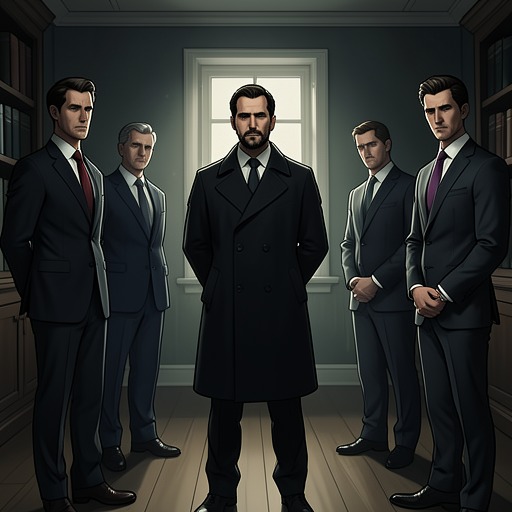
The Jackal—M. Goossens
The Day of the JackalThe Jackal’s dealings with M. Goossens turn an arms purchase into a compact study in professional trust without personal trust. Goossens supplies and modifies the weapon the assassin needs; The Jackal tests every part, judges the workmanship, and secures the secrecy of the transaction by recognizing the armourer’s precautions and making the consequences of disclosure unmistakable. Their connection rests on skill and guarded calculation rather than friendship: each understands the other’s competence, and each knows that a customer’s visit can become evidence.
A Transaction Built on Caution
On the morning he received a letter, The Jackal left the Amigo Hotel in Brussels and took a taxi to a corner near M. Goossens’s home. He had called the armourer over breakfast under the name Alexander Duggan, the identity by which Goossens knew him, and arranged an appointment for eleven. Arriving half an hour early, The Jackal watched the street from a bench in a small public garden, screening himself behind a newspaper. Only after deciding that the surroundings seemed quiet did he go to the door at the appointed time.
Goossens admitted him to a small room off the hallway, then locked the front door and secured its chain. These precautions frame the encounter before either man discusses the weapon: the customer surveys the street, while the supplier controls entry to the house. The Jackal’s appointment also depended on a promise made earlier. He reminded Goossens that, if he returned on August 1, the gun would be ready by August 4 for him to take away. Goossens confirmed that the gun itself was ready, but explained that the separate case had caused a delay because it had to be made from scratch. The work was not a simple sale of a finished rifle; the two men had agreed on a specialized commission with a deadline and distinct components.
The Armourer’s Work and the Customer’s Inspection
Goossens presented a flat case, about two feet long, eighteen inches wide, and four inches deep. Inside, shaped compartments held the rifle’s separate components. The Jackal did not accept the description at face value: he handled and examined the mechanism, checking how the bolt moved and locked. Goossens had added a steel disc behind it, with a threaded opening intended for the stock frame. The original wooden stock had been removed; its fixing holes were plugged and blued, and the old trigger had been cut flush with the breech. A small threaded metal piece and a curved steel trigger could be fitted to the modified assembly.
The weapon’s transformation was collaborative in a precise, practical sense. Goossens supplied the engineering, including the changes that allowed the stock to be assembled from separate parts; The Jackal fitted the pieces and tried the rifle himself. He joined the steel rods to their sockets, seated the butt, shouldered the resulting outline of a stock, and squeezed the trigger toward the far wall. The test produced a soft click. His inspection continued with the attachments: he fitted a silencer to the threaded barrel and examined the telescope, whose clips engaged grooves along the top of the barrel. The careful examination culminated in The Jackal’s approval of Goossens’s workmanship. His praise was not casual courtesy; the account presents both men as specialists who recognize the quality of the other’s work.
Final Fitting and Concealment
The following morning, Goossens called the work finished and asked Alexander Duggan to bring the necessary items for a final fitting. The Jackal again arrived thirty minutes early and watched the street before entering. He carried a small attaché case inside an otherwise empty fibre suitcase that he had bought second-hand that morning. The repeated surveillance and the choice of luggage make the fitting part of the same cautious operation as the initial inspection, rather than an unguarded workshop visit.
Goossens’s finished packing system kept the components separate and quiet. The longest tube, twenty inches long, held the barrel and breech; shorter tubes held the stock’s upper and lower struts, the silencer, and the telescope. The butt, with the trigger inside its padding, was separate, as was the rubber knob containing the bullets. The tubes’ interiors were lined with two layers of pale-grey baize, and The Jackal rattled them individually without hearing anything inside. Disassembled and divided among ordinary-looking containers, the weapon no longer presented itself as a rifle. The concealment was as important to their transaction as the rifle’s firing mechanism: Goossens had made a complete custom assembly that could be carried without appearing to be one.
The Jackal’s quiet verdict that the arrangement was exactly what he wanted pleased Goossens, who valued the approval of an expert customer. That moment of satisfaction marks the relationship’s closest approach to warmth, but it remains bounded by the work. Goossens is pleased as a skilled tradesman whose commission meets its client’s exacting requirements; The Jackal’s approval confirms that the delivered equipment answers his specifications. Neither response removes the danger surrounding the exchange.
Secrecy, Leverage, and Mutual Risk
When The Jackal referred to Goossens’s discretion, the armourer was frightened that the customer might kill him to ensure his silence. The Jackal answered that he had no intention of harming him, reasoning that a killing would create additional problems: police inquiries would expose his visits to the house before he could use the weapon. He also correctly anticipated that Goossens had arranged safeguards, naming possibilities such as a check-in call, a visitor who would discover a body, or a letter held by a lawyer. Goossens had in fact deposited a letter with a lawyer, instructing the police, in the event of his death, to search beneath a particular stone in the back garden. A box there contained a list of expected visitors, updated each day; the entry for that day described the tall, well-to-do Englishman calling himself Duggan.
The disclosure establishes that Goossens was not relying on the customer’s goodwill alone. His precautions created a record that could identify Alexander Duggan if anything happened to him, while The Jackal’s awareness of those precautions helped him explain why killing the armourer would be counterproductive. But reassurance had a limit. The Jackal warned that he would kill Goossens if he ever mentioned the visits or the purchase to anyone. Goossens, in turn, explained that he expected discretion from his customers and had removed the gun’s serial number with acid to protect himself. Their arrangement therefore combines a practical assurance against immediate violence with an explicit threat against future disclosure.
The Character of the Relationship
The Jackal and M. Goossens deal with each other through a narrow code: punctual appointments, controlled access, technical competence, payment implied by the commission, and silence enforced by self-protection and threat. Goossens’s care in designing the case and altering the rifle meets The Jackal’s repeated inspection; The Jackal’s praise acknowledges that care, but his warning makes clear that professional respect does not make the relationship safe. Goossens has prepared for the possibility of his customer’s violence, while The Jackal has assessed the consequences of causing it. Their cooperation succeeds because each can anticipate the other’s methods without mistaking that knowledge for trust.
The exchange also makes secrecy material. The rifle is divided into padded tubes; the visitor is recorded under an assumed name; the serial number is erased; and a letter and hidden list stand ready to expose the visit if Goossens dies. These details give the relationship its defining tension: Goossens helps make the weapon usable and concealable, yet takes steps to preserve evidence of who came to him, while The Jackal accepts the work and insists that the connection disappear from public knowledge. Their alliance is effective precisely because it remains transactional, expert, and wary.